- Client
- The National Department of Health (SBCC)
- Sector
- Public sector | Health
- Project
- Developing South Africa’s TB Social and Behaviour Change Communication Training Manual.

The Brief
Services
- Evidence-based research
- Gap analysis
- Publications
- Manual development
- Behaviour change communication
- Behavioural insights
- Behavioural strategy
- Behaviourally informed messaging
- Behaviourally driven intervention design
- M&E
The Challenge
An earlier needs assessment had to be expanded to include national geographic coverage, stakeholder representation and depth to provide input to a national resource. A single generic manual would also fail users with very different roles, technical knowledge and operating realities. The training manual had to make behavioural science practical, support digital and non-digital communication, provide tools people could use immediately, and TB communication had to be aligned with the national strategy.
The Science
We used behaviour models to find where action was blocked - then designed the research and manual around those barriers. BCA combined survey data and in-depth interviews with each stakeholder group, across the 9 provinces. It aimed to understand what people needed, where barriers sat, and how a national resource could work in real implementation settings. The evidence pointed to role-specific pathways, accessible examples and visuals, ready-to-use planning and message-testing tools, and continuous feedback loops.
The Insights
The research showed that different users did not simply need more information. They needed the right information, in the right form, for the decisions they make every day. Community-level workers, coordinators and campaign planners, and strategists and decision-makers each needed a clear route through the material. Across every role, the starting point was the same: understand the behaviour and the barriers before choosing messages or media.
The Intervention
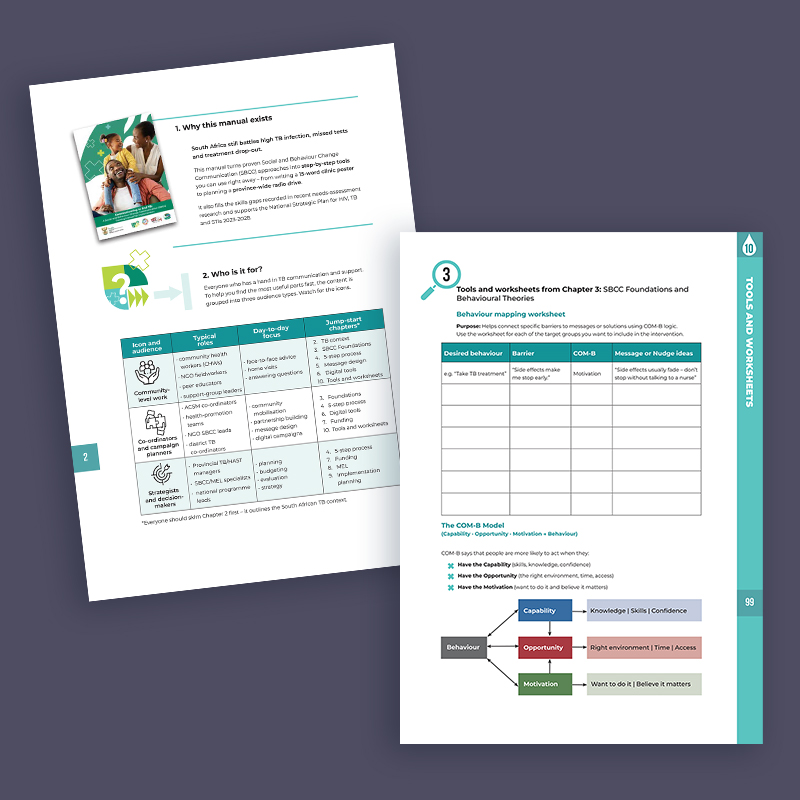
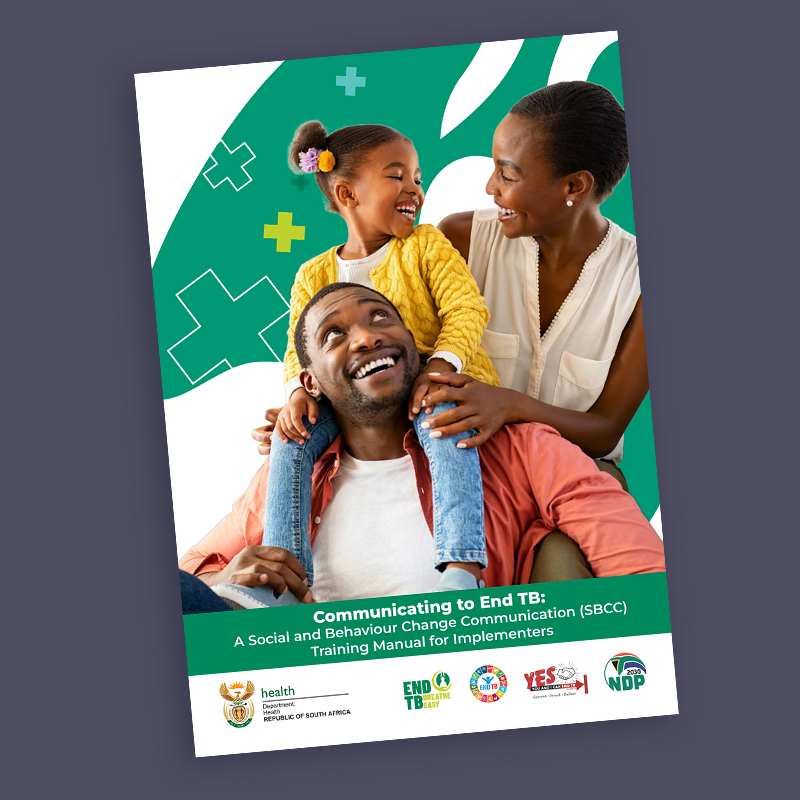
BCA turned the evidence into Communicating to End TB: an SBCC Training Manual for Implementers. It combines behavioural foundations with a five-step planning process, personas, message design, channel selection, implementation tools, monitoring and learning, and facilitation guidance.
Chapter tabs, colour coding, icons, short summaries, glossaries, worksheets and apply sections make the resource fast to navigate and easy to adapt to real work.
The Impact
Tested with the people expected to use it - then improved.
The manual was piloted over three-sessions to test clarity, usefulness and fit with day-to-day implementation. Feedback was built into the final version.
The result is a field-ready resource with a consolidated toolbox and training guidance. NDoH described it as technically strong, practical and suitable for South Africa's TB response.
The outcome is more than a manual. It is a practical system for turning TB communication into behaviour-focused action.